Table of Contents
ToggleHigh-rise buildings dominate modern skylines. From residential towers overlooking the Swan River to commercial skyscrapers rising, these vertical structures depend on far more than concrete and steel. Hidden behind walls, ceilings, and service shafts lies a complex network of mechanical, electrical, and plumbing systems.
That hidden network is documented and coordinated through MEP Drawings for High-Rise Building projects. Without precise planning, tall structures would struggle with ventilation, power distribution, water supply, and fire safety.
Design teams rely on high-rise building MEP drawings to guide contractors, engineers, and architects during construction. These plans take messy engineering systems and turn them into a clear map so every pipe and duct fits exactly where it should inside the tower.
With high-density towers going up on every corner in our growing cities, MEP Drawings for tall buildings is the real backbone of the whole project’s safety.
Understanding MEP Drawings for High-Rise Building Projects
Every skyscraper needs a solid, coordinated set of MEP Drawings for High-Rise Building plans just to work. These drawings show exactly how the mechanical gear, power grids, and plumbing all fit together inside the structure.
Instead of vague diagrams, detailed MEP drawings for skyscraper construction provide precise dimensions, equipment specifications, and installation instructions.
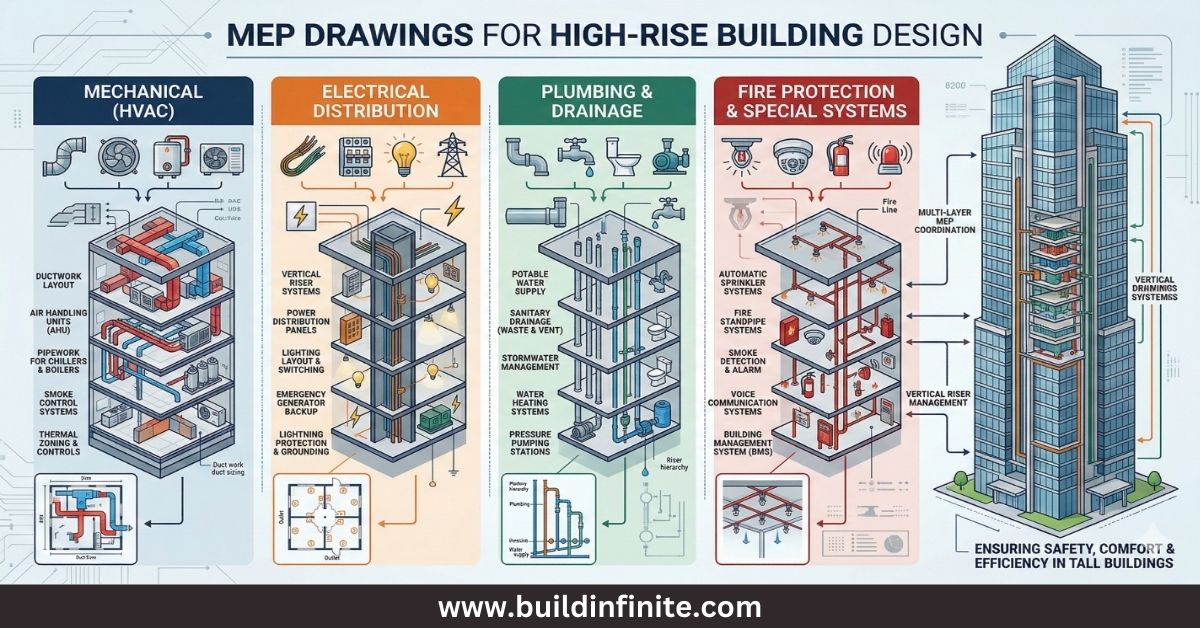
Three core systems form the backbone of every high-rise project:
| System | Purpose in High-Rise Buildings | Example Components |
|---|---|---|
|
Mechanical |
Maintains indoor comfort and ventilation |
HVAC units, ducts, chillers |
|
Electrical |
Distributes power safely across floors |
Panels, cable trays, transformers |
|
Plumbing |
Supplies water and removes waste |
Pipes, pumps, drainage stacks |
When engineers produce MEP engineering drawings for tall commercial buildings, every component must be carefully located to avoid clashes with structural beams, columns, and architectural elements.
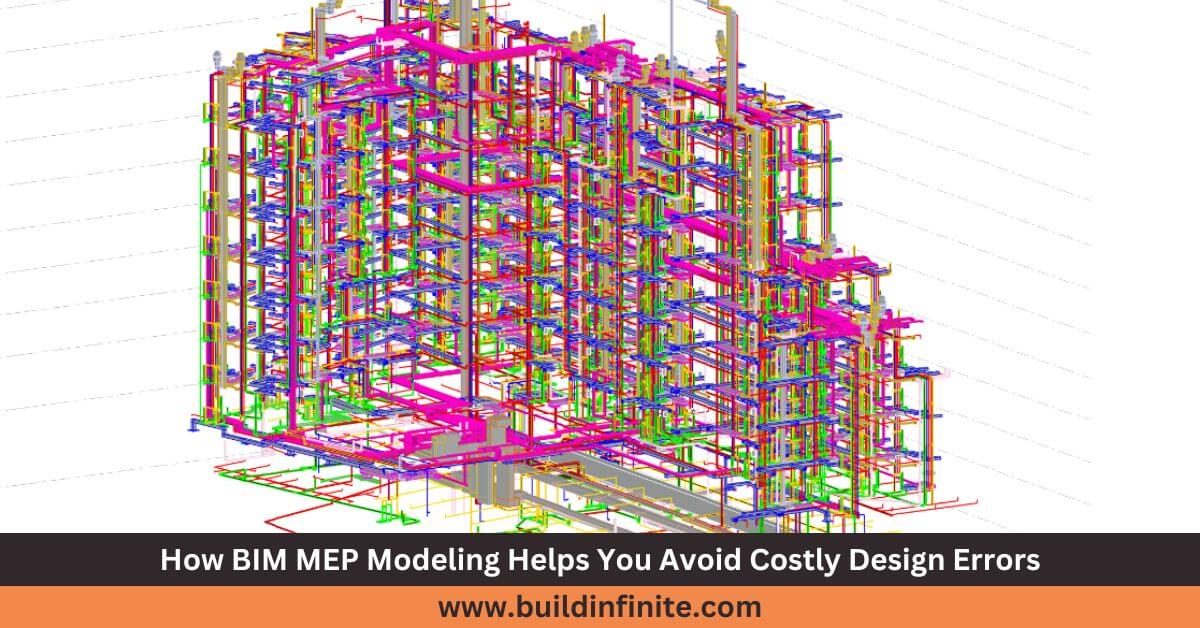
Most modern jobs now rely on BIM-based MEP drawings for high-rise towers built in Revit. These models make it much easier for teams to work together and see how complex systems fit before anyone picks up a tool.
In many engineering projects, consultants also prepare a complete MEP Drawings List that outlines every mechanical, electrical, and plumbing drawing required for the building.
Importance of MEP Drawings in High-Rise Building Design
Tall buildings demand precision. Even a minor coordination mistake can lead to costly delays or safety issues.
That is why the importance of MEP drawings in high-rise building design continues to grow as buildings become taller and more technologically advanced. Several factors make these drawings essential.
- Accurate MEP layout for high-rise projects helps engineers plan equipment rooms, shafts, and service corridors.
- Getting the MEP coordination in high-rise buildings right is the only way to stop pipes and ducts from smashing into structural beams or electrical lines.
- Having detailed plans makes getting through council approvals and building codes a breeze.
- Plus, a smart layout means way fewer maintenance headaches once the building is occupied.
Tall towers need incredibly precise MEP systems design for skyscrapers, especially when you have hundreds of people counting on steady power, AC, and water.
You’ve got to manage ventilation, power risers, and plumbing stacks that need to run vertically through dozens of different levels. Without well-structured MEP drafting services for high-rise buildings, coordination between these systems becomes nearly impossible.
Mechanical Systems and HVAC Drawings for High-Rise Buildings
Comfort inside a tall building depends heavily on mechanical engineering systems. Cooling systems must work efficiently during hot summers while maintaining energy performance.
This is where HVAC drawings for high-rise buildings become critical. Mechanical plans describe the layout of:
- Air handling units
- Chillers and cooling towers
- Ventilation ducts
- Mechanical shafts
- Exhaust systems
In high-rise structures, airflow must travel vertically and horizontally through long duct routes. Engineers design these networks using HVAC system design for high-rise buildings, ensuring balanced air pressure and temperature across every floor.
Energy efficiency also plays a role. A lot of the newer towers are packed with VAV systems, smart tech, and energy-recovery gear to keep things efficient. Through MEP system planning for high-rise residential buildings, designers ensure comfortable indoor environments while reducing operating costs.
Electrical Layout for High-Rise Construction
Electricity powers every system within a tower, including lighting, lifts, security systems, data infrastructure, and building automation. For that reason, the electrical layout for high-rise construction demands careful planning.
Electrical engineers produce electrical distribution designs for high-rise towers that show how power flows from transformers and switchboards through the building’s vertical risers.
Key electrical elements include:
- Main switchboards and sub-distribution panels
- Cable tray systems
- Emergency backup generators
- Fire alarm networks
- Lighting systems
For complex builds, MEP engineering drawings for tall commercial buildings make sure your electrical runs stay well clear of the plumbing and mechanical lines. Having rock-solid power distribution is a must for hospitals and data centers, where even one minute of downtime becomes a total disaster.
Plumbing Drawings for Skyscrapers and Vertical Water Systems
Water distribution in tall buildings introduces unique challenges. Unlike low-rise structures, gravity alone cannot move water across dozens of floors. Because of this, Plumbing drawings for skyscrapers have to map out specific pressure zones, pump systems, and storage tanks.
Vertical pipes known as risers distribute water and drainage between floors. Engineers represent these systems through plumbing riser diagrams for tall buildings, which show how pipes travel through shafts from the basement to the rooftop.
Key plumbing components often include:
- Domestic water supply systems
- Drainage and waste pipes
- Rainwater harvesting systems
- Booster pump stations
- Fire sprinkler piping
These configurations are vital to MEP systems design for skyscrapers, making sure water pressure stays steady no matter which floor you’re on.
MEP Coordination and Clash Detection in High-Rise Buildings
High-rise construction involves dozens of engineering disciplines working simultaneously. Without coordination, ductwork could intersect with beams, pipes could clash with electrical trays, and costly on-site rework would occur.
This is exactly where MEP clash detection for high-rise buildings earns its keep. By sticking to Revit MEP modeling for high-rise projects, engineers can catch conflicts between the structure and services before they turn into costly errors.
Today’s MEP BIM coordination for skyscrapers uses 3D sims to catch problems weeks or months before the first brick is laid.
The process usually follows this workflow:
- Architectural and structural models are developed.
- Mechanical, electrical, and plumbing engineers create their system models.
- Coordination software identifies clashes between systems.
- Design adjustments eliminate conflicts.
Good prep makes sure structural and MEP coordination for tall buildings actually works, which saves everyone from massive delays and budget blowouts.
MEP Shop Drawings for High-Rise Buildings
After the design gets the green light, contractors look to MEP shop drawings for high-rise buildings to actually get the gear installed.
Shop drawings aren’t just pretty pictures; they focus on the actual site conditions, including exact measurements and how the equipment needs to be mounted.
These documents ensure that:
- Fabricated ductwork fits structural spaces
- Pipe supports align with structural elements
- Equipment rooms maintain safe clearances
- Maintenance access remains available
On-site crews use building services drawings for high-rise buildings every single day to stay in sync. In a skyscraper, even a tiny error gets magnified across 50 floors, which is why MEP drafting services for high-rise buildings have to be spot-on.
BIM-Based MEP Drawings for High-Rise Towers
The shift toward digital construction has transformed engineering workflows. Most big projects now use BIM-based MEP drawings for high-rise towers to keep a massive amount of data organized in one spot.
BIM tech gives engineers a chance to see the whole service network in 3D before a single pipe is fitted. Instead of flat drawings, three-dimensional models show ducts, pipes, and cables running through the structure.
Advantages of BIM include:
- Accurate high-rise building MEP coordination workflow
- Faster design revisions
- Improved cost estimation
- Better facility management data after construction
In Revit MEP modeling for high-rise projects, design teams integrate mechanical, electrical, and plumbing systems into a single coordinated model. Digital workflows help architects and engineers deliver more efficient skyscrapers.
Many international developers now collaborate with a specialised MEP CAD Provider to produce BIM-ready models that improve coordination between architects, engineers, and contractors.
Design Standards for MEP Systems in High-Rise Buildings
High-rise engineering follows strict regulations and best-practice guidelines. Compliance with MEP design standards for high-rise buildings ensures occupant safety and system reliability.
Important standards often include:
- Fire protection and sprinkler system codes
- Electrical safety and load distribution rules
- Ventilation and indoor air quality standards
- Energy efficiency guidelines
Proper fire protection drawings for high-rise buildings also form a vital part of the design process. These plans show sprinkler layouts, fire pumps, alarm systems, and emergency evacuation infrastructure. Together, these systems ensure the safety of residents and workers in tall buildings.
How MEP Drawings Improve Construction Efficiency
Most construction timelines live or die by how well the design and installation teams coordinate with each other.
Clear MEP Drawings for High-Rise Building projects deliver multiple advantages.
- Contractors receive accurate installation guidance
- Equipment locations remain consistent across floors
- Construction delays caused by system clashes decrease
- Maintenance teams gain clear documentation after project completion
In massive towers, MEP layouts for high-rise projects are the foundation of site coordination; without these plans, fitting out dozens of floors would be pure chaos.
Future Trends in High-Rise MEP Engineering
Engineering for these massive builds is constantly changing as new tech and sustainability goals come into play. Several trends are shaping the future of MEP systems design for skyscrapers:
Smart building automation systems are becoming standard in commercial towers. Sensors monitor air quality, energy use, and system performance in real time.
Sustainable builds are becoming the norm. Designers are now baking energy-saving HVAC, solar gear, and water-recycling tech directly into their MEP system planning for high-rise residential buildings.
Digital twin technology is another emerging trend. BIM models are now helping with building maintenance long after the builders leave. These tools are the key to how MEP engineering drawings for tall commercial buildings are creating smarter cities.
Conclusion
Today’s skyscrapers live and breathe through the systems hidden in the walls—everything from the air you breathe to the fire protection that keeps you safe. This is why MEP Drawings for High-Rise Building plans are so vital. When you combine tight coordination and BIM, you get a building that actually works properly for decades.
As we keep building upward, the need for expert MEP drafting services for high-rise buildings and smart BIM coordination is only going to grow. Professional engineering expertise ensures every pipe, cable, and duct fits perfectly within the building structure.
Reach out for a quote on professional MEP drafting and BIM coordination. Solid documentation makes for a safer, smoother build. Planning it right today protects the future of our skyline.
Frequently Asked Questions
What are MEP Drawings for High-Rise Building projects?
MEP Drawings for High-Rise Building sets basically map out a tower’s guts, guiding the install of HVAC, power, and fire systems so everything runs safely.
Why are high-rise building MEP drawings important?
High-rise building MEP drawings are what engineers use to keep systems in check. They prevent pipes and cables from competing for the same tight spaces while ensuring every inch of the build meets safety codes.
What is MEP coordination in high-rise buildings?
Basically, MEP coordination in high-rise buildings is about making sure the mechanical, electrical, and plumbing stuff all fits around the structure without any overlaps.
How does BIM improve MEP drawings for skyscrapers?
Using BIM-based MEP drawings for high-rise towers lets you see the whole thing in 3D before you start. It catches errors early and keeps all your data in one reliable place.
What systems are included in MEP design for tall buildings?
At the end of the day, MEP design for tall buildings covers all the HVAC, power grids, plumbing, and fire tech that modern towers need to actually work.
What are MEP shop drawings for high-rise buildings?
MEP shop drawings for high-rise buildings provide detailed construction instructions for contractors. These drawings show exact installation locations, equipment specifications, and fabrication details needed for mechanical, electrical, and plumbing systems.